What the Cartel FTO Designation Means for Your Task Force’s Case Documentation
On February 20, 2025, six Mexican cartels were officially designated as Foreign Terrorist Organizations (FTOs). The Sinaloa Cartel, CJNG, Gulf Cartel, Cartel del Noreste, La Nueva Familia Michoacana, and Carteles Unidos joined MS-13 and Tren de Aragua on the FTO list.
For narcotics investigators, this was more than a policy announcement.
It fundamentally changed cartel FTO designation task force documentation requirements.
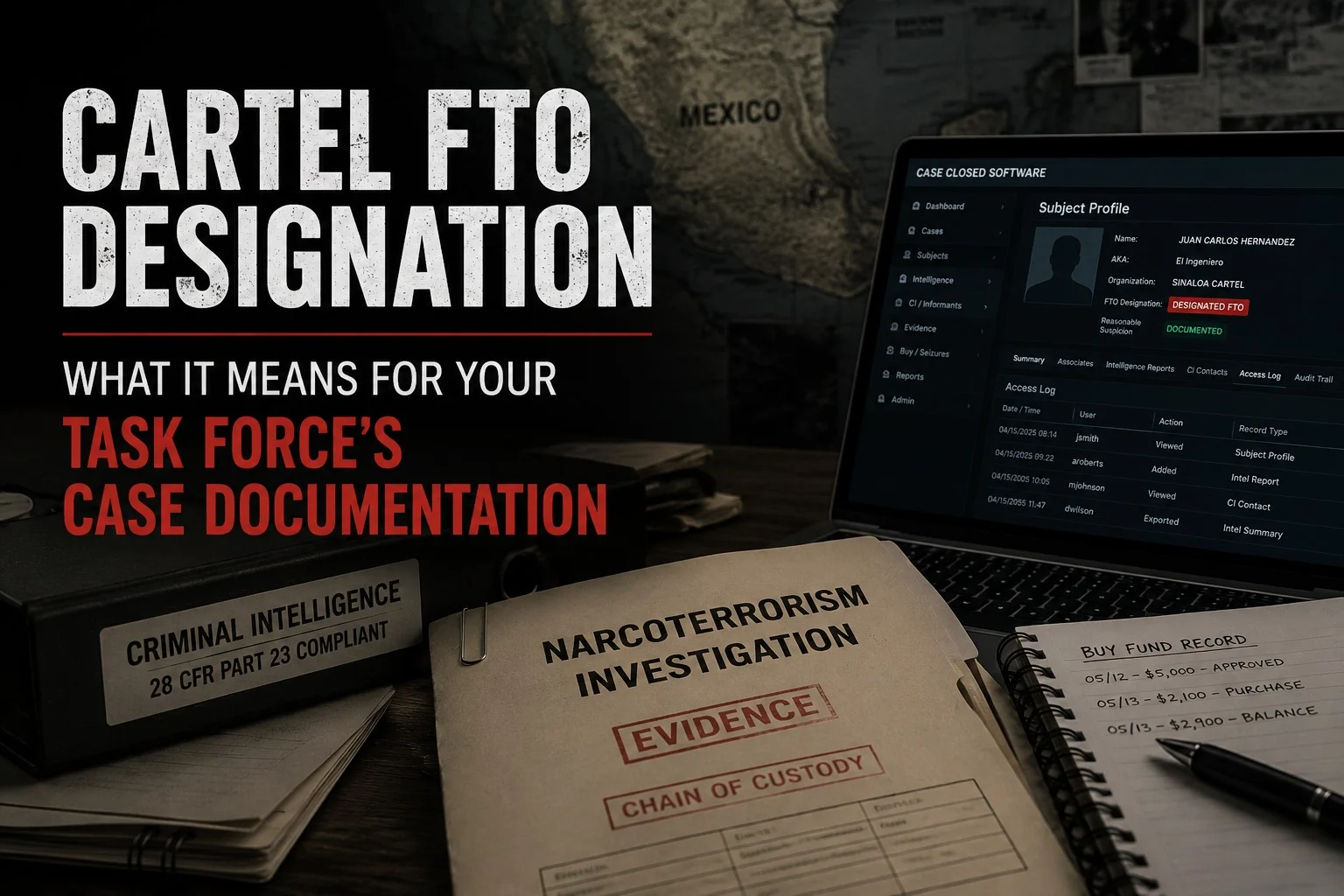
Cases that once centered solely on narcotics trafficking may now involve federal terrorism statutes, placing greater emphasis on investigative documentation, criminal intelligence records, controlled buy tracking, confidential informant management, and evidence preservation.
Why Cartel FTO Designation Task Force Documentation Matters
Federal prosecutors are increasingly pursuing charges that extend beyond traditional drug trafficking offenses.
Investigations connected to designated cartels may now involve:
- Narcoterrorism
- Material support for a Foreign Terrorist Organization
- Organized criminal enterprise investigations
- Multi-agency federal task force prosecutions
This means every investigative record may become critical evidence.
Modern cartel FTO designation task force documentation must demonstrate not only criminal activity but also documented connections between suspects and designated terrorist organizations.
Federal Terrorism Cases Require More Than Standard Drug Case Documentation
Traditional narcotics investigations primarily focused on proving possession, trafficking, conspiracy, or distribution.
Federal terrorism prosecutions introduce additional documentation requirements.
Investigators may need to establish:
- Documented cartel affiliation
- Intelligence supporting organizational relationships
- Financial transactions supporting cartel activity
- Controlled buy documentation
- Informant reliability
- Dissemination history
- Complete investigative chain of custody
Each investigative action may later become part of federal courtroom evidence.

Criminal Intelligence Records Must Be Stronger Than Ever
One of the biggest changes involves criminal intelligence documentation.
Effective cartel FTO designation task force documentation requires investigators to clearly document:
- Reasonable suspicion
- Intelligence source
- Cartel affiliation
- Supporting investigative facts
- Dates of collection
- Review history
Simply identifying someone as a suspected trafficker is no longer sufficient if prosecutors must prove support for a designated Foreign Terrorist Organization.
Controlled Buy Documentation Carries Greater Weight
Controlled buys have always required accurate documentation.
Today they may also establish financial support flowing toward a designated cartel.
Proper documentation includes:
- Buy fund authorization
- Currency issuance
- Serial number tracking
- Chain of custody
- Informant payments
- Evidence collection
- Supervisory approval
- Final reconciliation
Every transaction should be traceable from beginning to end.
Confidential Informant Documentation Becomes Critical Evidence
Confidential informants often become central witnesses in cartel investigations.
Their files should clearly document:
- Reliability history
- Source evaluations
- Handler authorizations
- Contact logs
- Information provided
- Payments
- Background reviews
- Operational approvals
Modern cartel FTO designation task force documentation requires complete accountability throughout the informant lifecycle.
Intelligence Sharing Must Be Fully Documented
Large cartel investigations frequently involve:
- HIDTA task forces
- DEA
- FBI
- Homeland Security Investigations
- State investigators
- Local agencies
Every dissemination should document:
- What information was shared
- Date and time
- Receiving agency
- Authorizing supervisor
- Purpose of dissemination
These records may later become important evidence during prosecution.
The Importance of 28 CFR Part 23
The increased importance of cartel FTO designation task force documentation also highlights the value of 28 CFR Part 23 compliance.
The regulation requires:
- Documented reasonable suspicion
- Controlled intelligence collection
- Access logging
- Dissemination documentation
- Scheduled retention reviews
- Purging of outdated intelligence
These safeguards improve both compliance and investigative credibility.
When federal prosecutors review investigative files, complete documentation strengthens the integrity of the investigation.
Many Task Force Documentation Systems Were Not Built for This
Many narcotics task forces still manage investigations using a combination of:
- RMS platforms
- Shared drives
- Paper files
- Excel spreadsheets
These disconnected systems make it difficult to produce a complete investigative record.
Important information may exist in multiple locations, making audits, prosecutions, and interagency collaboration more challenging.
What Modern Task Force Documentation Should Include
Today’s investigations benefit from documentation systems that can securely manage:
- Criminal intelligence records
- Controlled buy tracking
- Buy fund accounting
- Confidential informant management
- Evidence tracking
- Case management
- Supervisory approvals
- Dissemination logs
- Audit trails
- Relationship mapping
Keeping these records together improves investigative efficiency while supporting long-term documentation needs.
Preparing for Future Prosecutions
Federal investigations often continue for years.
Task forces may be asked to produce records long after an investigation begins.
Strong cartel FTO designation task force documentation ensures investigators can quickly locate:
- Intelligence predicates
- Case histories
- Informant documentation
- Buy fund records
- Dissemination history
- Access logs
- Supervisory approvals
Comprehensive documentation supports continuity as personnel, assignments, and agencies change over time.
How Case Closed Software Supports Task Force Documentation
Case Closed Software provides an integrated investigative platform designed for narcotics units, criminal intelligence teams, gang investigators, and multi-agency task forces.
The platform helps agencies manage:
- Criminal intelligence documentation
- Controlled buy management
- Buy fund accounting
- Confidential informant records
- Case management
- Evidence tracking
- Supervisory workflows
- Secure audit trails
- 28 CFR Part 23 support
By keeping investigative documentation connected inside one platform, agencies can improve organization, strengthen accountability, and support complex investigations.
Modern Investigations Require Modern Documentation
The designation of major cartels as Foreign Terrorist Organizations has increased the importance of comprehensive investigative documentation.
Task forces that maintain organized intelligence records, controlled buy documentation, confidential informant files, and secure audit trails are better positioned to support complex investigations and future prosecutions.
Modern cartel FTO designation task force documentation is no longer simply administrative.
It is an essential part of building strong, defensible investigations.
Frequently Asked Questions
What is cartel FTO designation task force documentation?
Cartel FTO designation task force documentation refers to the investigative records maintained when cases involve organizations designated as Foreign Terrorist Organizations, including intelligence, controlled buys, confidential informants, and evidence documentation.
Why is cartel FTO designation task force documentation important?
It helps investigators maintain complete, organized records that support complex federal investigations, intelligence sharing, and long-term case management.
What records should narcotics task forces maintain?
Modern task forces should document criminal intelligence, controlled buys, confidential informant activity, buy fund transactions, dissemination records, evidence, supervisory approvals, and audit trails.
How does case management software improve cartel FTO designation task force documentation?
Integrated investigative software centralizes intelligence, documentation, evidence, and workflow management, reducing duplicate data entry while improving organization, accountability, and long-term record retention.


