District Attorney Investigation Case Management Software: The Missing Piece in Modern Prosecutor’s Offices
The Investigative Side of the Prosecutor’s Office Is Often Overlooked
Search for district attorney investigation case management software, and you’ll find dozens of platforms designed for prosecutors. Most focus on docket management, court scheduling, discovery deadlines, referral intake, and legal workflows.
Those capabilities are essential.
But they are not designed for sworn investigators.
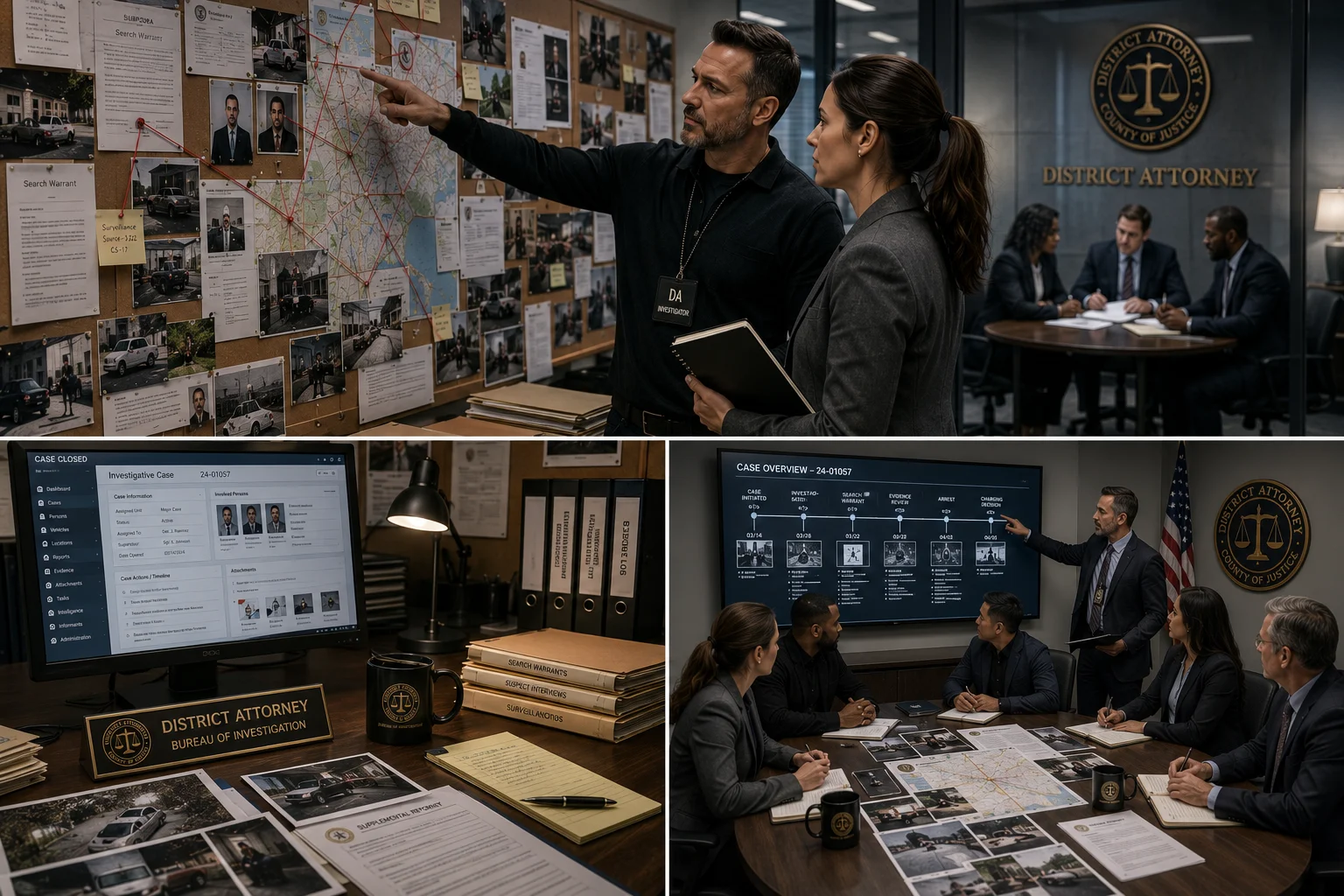
Many large district attorney’s offices operate their own investigative bureaus staffed by licensed peace officers who conduct field investigations, execute search warrants, interview witnesses, perform surveillance, and develop the evidence that ultimately supports prosecution.
These professionals are investigators—not attorneys or paralegals—and they need software built for investigative work.
That is where district attorney investigation case management software fills a critical gap.
Two Different Operations Require Two Different Workflows
Inside most large prosecutor’s offices, two very different operations work together.
The legal side manages:
- Court calendars
- Discovery obligations
- Case referrals
- Hearings
- Trial preparation
- Docket management
Meanwhile, the investigative bureau manages:
- Criminal investigations
- Search warrants
- Witness interviews
- Surveillance operations
- Supplemental reports
- Case assignments
- Evidence collection
Legal case management systems excel at courtroom administration.
They are not designed to support detective workflows.
Modern district attorney investigation case management software gives sworn investigators the same investigative tools used by narcotics units, gang units, major crimes divisions, and multi-agency task forces.
Why Many DA Investigative Bureaus Still Use Homegrown Systems
Because investigative bureaus sit somewhere between traditional law enforcement and legal operations, many offices continue relying on aging in-house systems.
Common examples include:
- Legacy ActiveX applications
- Microsoft Access databases
- Word document templates
- Shared network folders
- Manual approval processes
- Email-based report routing
These systems often worked well when they were created.
However, over time they become difficult to maintain.
Browser updates break older software.
Key personnel retire.
Institutional knowledge disappears.
Eventually, the office is forced to replace critical investigative software under significant time pressure.
Purpose-built district attorney investigation case management software eliminates this risk while preserving established investigative workflows.
What District Attorney Investigation Case Management Software Should Include
Unlike legal case management platforms, investigative software must reflect how detectives actually work.
A modern solution should support:
Case Intake and Assignment
Cases should be assigned by:
- Unit
- Supervisor
- Investigator
- Case type
- Priority level
Whether the office investigates fraud, cybercrime, public integrity, major crimes, or financial crimes, the system should match the organization’s operational structure.
Supervisory Approval Workflow
Investigative reports require structured review.
Modern district attorney investigation case management software should allow investigators to:
- Submit supplemental reports
- Route reports electronically
- Receive supervisor comments
- Track approvals
- Maintain complete approval histories
Electronic approval workflows improve accountability while eliminating paper routing.
Configurable Investigative Reports
Investigators already know the report formats their offices use.
The software should adapt to those formats—not require investigators to learn entirely new documentation methods.
Custom report templates help maintain consistency while reducing administrative burden.
Role-Based Security
District attorney offices contain multiple user groups.
The software should support:
- Investigators
- Sergeants
- Lieutenants
- Bureau commanders
- Prosecutors
- Administrative personnel
Attorneys may require read-only access to investigative files without modifying active investigations.
Modern district attorney investigation case management software supports these permissions through role-based access controls.
Room to Expand
Investigative needs continue evolving.
A scalable investigative platform should also support:
- Evidence management
- Criminal intelligence
- Confidential informant management
- Digital evidence
- Attachment management
- Search warrant tracking
- Case analytics
Rather than purchasing multiple disconnected systems, agencies benefit from one integrated investigative platform.
Why Traditional Legal Case Management Software Falls Short
Legal software vendors understand courtroom operations exceptionally well.
They build solutions for:
- Prosecutors
- Court clerks
- Discovery management
- Calendar scheduling
- Legal document management
Law enforcement vendors understand investigations.
They build software for:
- Police departments
- Sheriff’s offices
- Narcotics units
- Gang units
- Criminal intelligence divisions
Large district attorney investigative bureaus exist between those two worlds.
As a result, many organizations struggle to find district attorney investigation case management software designed specifically for their operational environment.
A Better Approach for Modern Investigative Bureaus
Purpose-built investigative software allows DA investigative bureaus to work the same way detectives do.
Core capabilities include:
- Case assignment by unit and supervisor
- Investigative timelines
- Supplemental reporting
- Search warrant documentation
- Witness management
- Attachment storage
- Digital evidence
- Investigator activity logs
- Supervisory approval workflows
- Complete audit trails
Instead of adapting legal software to investigative work, agencies gain software built specifically for investigative operations.
Case Closed Software Supports the Entire Investigative Workflow
Case Closed Software was designed around investigative workflow rather than courtroom administration.
The platform supports:
- District attorney investigative bureaus
- Major crimes units
- Public integrity divisions
- Fraud investigators
- Cybercrime investigators
- Criminal intelligence units
- Multi-agency investigative teams
Investigators can manage cases from initial assignment through final prosecution while maintaining secure documentation, structured approvals, and comprehensive investigative records.
Conclusion
Prosecutor’s offices have always operated two distinct missions.
One manages the legal process.
The other conducts criminal investigations.
Traditional legal case management software addresses the courtroom.
Modern district attorney investigation case management software addresses the investigation.
For offices operating sworn investigative bureaus, purpose-built investigative software provides the detective workflows, supervisory oversight, evidence management, and reporting capabilities needed to support today’s complex investigations.
Frequently Asked Questions (FAQ)
What is district attorney investigation case management software?
District attorney investigation case management software is a specialized investigative platform designed for sworn investigators working inside prosecutor’s offices. It supports case management, investigations, evidence tracking, reporting, and supervisory workflows.
Why can’t prosecutors use traditional legal case management software for investigations?
Traditional legal software focuses on court calendars, discovery, and legal case administration. Investigators require detective-focused tools such as case assignments, investigative reports, evidence management, search warrant tracking, and supervisory approvals.
What features should district attorney investigation case management software include?
Essential features include case assignment, investigative reporting, supervisory approval workflows, evidence management, role-based permissions, attachment management, criminal intelligence support, and secure audit trails.
Who uses district attorney investigation case management software?
The software is designed for sworn investigators working within district attorney offices, including public integrity units, fraud investigators, cybercrime investigators, major crimes bureaus, and other investigative divisions.


