Gang Database Built for 2026: The Gang Database Playbook Hasn’t Changed Since 1997. Ours Just Did.
The Software Running Most Gang Databases Was Built for a Different Era
The software running most gang databases in this country predates the smartphone.
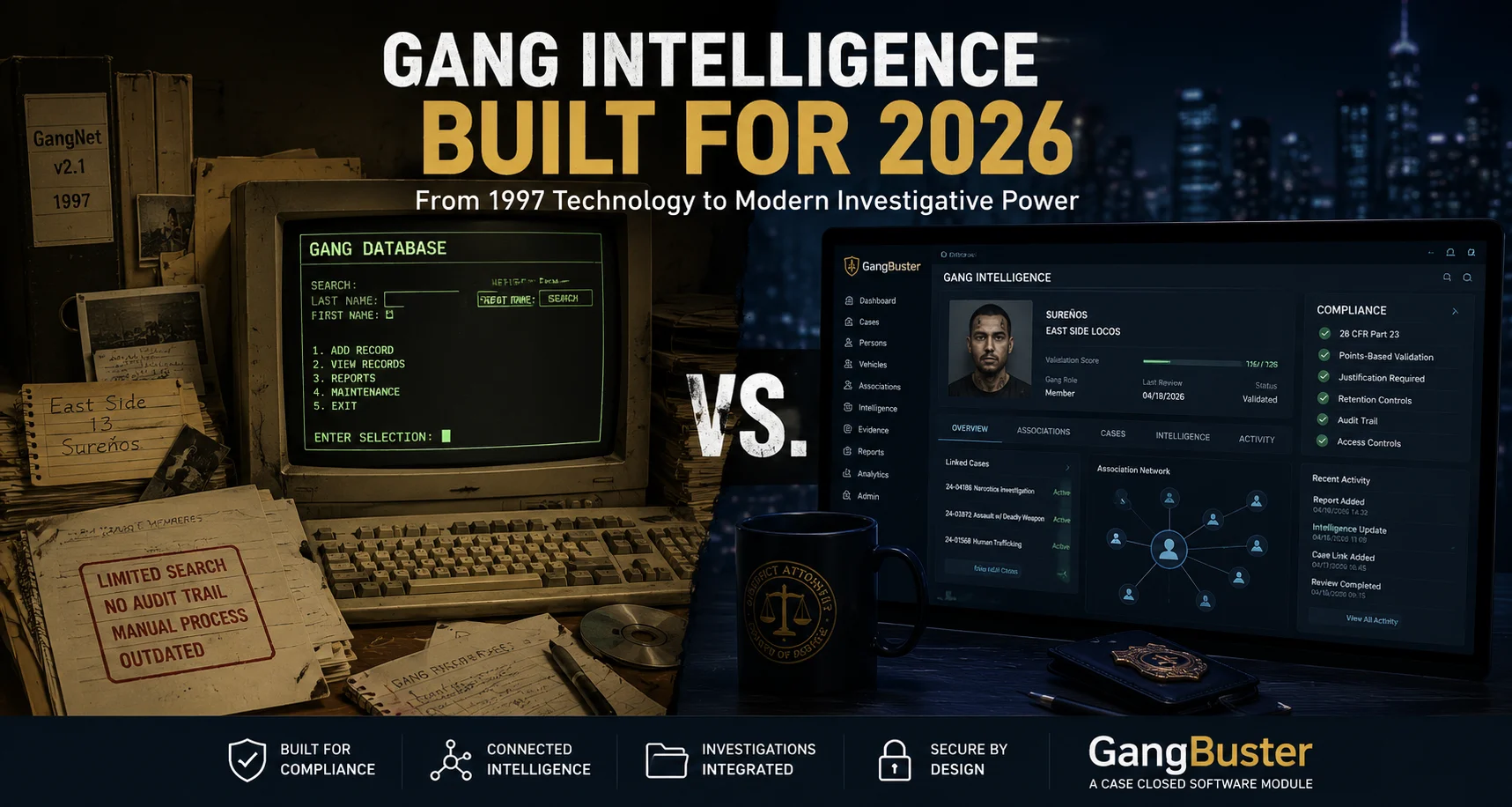
GangNet, the platform behind CalGang and its counterparts across the United States, was originally built in 1997. At the time, it represented a major advancement by giving agencies a shared, searchable way to manage gang intelligence instead of relying on paper files, index cards, and institutional memory.
But investigative technology has changed dramatically over the past three decades.
A gang database built for 2026 should do far more than simply store records.
It should connect gang intelligence directly to investigations, criminal intelligence, narcotics cases, human trafficking investigations, fraud cases, and every other investigative workflow that modern law enforcement agencies manage.
Lessons Learned From Nearly Three Decades of Legacy Systems
The limitations of older gang database platforms have become well documented.
A 2016 California State Auditor report found significant issues involving inadequate documentation, inaccurate data, and failures to follow established privacy procedures within CalGang.
County participation declined significantly following the report.
LAPD officers were later criminally charged for falsifying gang-affiliation entries.
California eventually passed the Fair and Accurate Gang Database Act of 2017, requiring stronger documentation, review procedures, and retention requirements.
Those safeguards were added after problems occurred.
A gang database built for 2026 starts with those safeguards built directly into the platform rather than relying on policy changes after the fact.
Compliance Is the Starting Point, Not the Competitive Advantage
Today’s gang intelligence platforms commonly advertise:
- 28 CFR Part 23 compliance
- Audit trails
- Points-based validation
- Documentation requirements
Those capabilities are no longer differentiators.
They are expected.
The real question is what a gang database built for 2026 actually helps investigators accomplish after someone has been entered into the system.
Knowing that someone is a documented gang member is useful.
Understanding how that individual connects across active investigations is where modern investigative value begins.
Gang Intelligence Should Never Live in a Separate Database
Many gang intelligence systems remain standalone databases.
They maintain:
- Member records
- Tattoos
- Photographs
- Associates
- Validation documentation
But investigations do not happen inside isolated databases.
A documented gang member may appear as:
- A suspect in a narcotics investigation
- An associate in a human trafficking case
- A subject in a fraud investigation
- A victim in a violent crime investigation
- A witness in another active case
Standalone systems force investigators to manually search multiple applications to connect these relationships.
A gang database built for 2026 should automatically surface these investigative connections without requiring duplicate searches.

A Gang Database Built for 2026 Connects Every Investigation
Modern investigative work depends on connected intelligence.
Instead of functioning as an isolated repository, a gang database built for 2026 integrates directly with:
- Criminal intelligence
- Case management
- Narcotics investigations
- Human trafficking investigations
- Fraud investigations
- Digital evidence
- Confidential informant management
- Investigative reporting
When a documented gang member appears in any investigation, investigators immediately see prior involvement across authorized cases.
The gang designation becomes an active investigative data point rather than a static record.
Connected Intelligence Produces Better Investigations
Investigators rarely solve cases by looking at a single database.
They solve cases by identifying relationships.
Modern gang intelligence platforms should automatically connect:
- People
- Vehicles
- Addresses
- Organizations
- Evidence
- Cases
- Associates
- Criminal intelligence records
A gang database built for 2026 allows investigators to identify those relationships in real time instead of relying on institutional memory or manual cross-referencing.
Built for Today’s Compliance Requirements
Modern agencies expect more than basic record storage.
A gang database built for 2026 should support:
- 28 CFR Part 23 compliance
- Structured validation requirements
- Role-based permissions
- Automated retention schedules
- Audit logging
- Review workflows
- Secure cloud infrastructure
- CJIS-compliant deployment
Compliance becomes part of the system architecture instead of depending entirely on administrative oversight.
Built New, Not Built Around Legacy Limitations
GangBuster launched in 2026 as a dedicated gang intelligence module inside an established investigative platform already supporting narcotics units, criminal intelligence programs, confidential informant management, and complex investigations.
Because it was built recently, it incorporates decades of operational experience and lessons learned from legacy gang database systems.
Rather than adapting technology designed in the 1990s, a gang database built for 2026 reflects current investigative workflows, compliance expectations, and multi-agency collaboration requirements from the ground up.
Why a Gang Database Built for 2026 Matters
Gang intelligence has traditionally been treated as a standalone database problem.
Modern investigations demand something different.
A gang database built for 2026 should help investigators:
- Connect gang intelligence to active investigations
- Surface relationships automatically
- Reduce duplicate data entry
- Improve investigative visibility
- Strengthen compliance
- Support multi-unit collaboration
- Deliver actionable intelligence rather than isolated records
The result is a platform that supports investigators throughout the entire investigative lifecycle instead of simply storing gang records.
Conclusion
Law enforcement agencies no longer need gang intelligence systems that function as isolated databases.
A gang database built for 2026 provides connected intelligence, integrated investigations, stronger compliance, and modern investigative workflows designed for today’s operational realities.
Instead of simply identifying who belongs in a gang database, modern platforms help investigators understand how that intelligence influences every investigation moving forward.
Frequently Asked Questions (FAQ)
What is a gang database built for 2026?
A gang database built for 2026 is a modern gang intelligence platform that connects gang records with case management, criminal intelligence, narcotics investigations, and other investigative workflows instead of operating as a standalone database.
Why is a gang database built for 2026 better than legacy systems?
Modern platforms include integrated investigations, automated compliance features, structured validation, role-based security, audit trails, and connected intelligence that older systems were not originally designed to support.
How does a gang database built for 2026 improve investigations?
It automatically connects gang members with related people, vehicles, addresses, cases, and criminal intelligence records, allowing investigators to identify patterns and relationships much faster.
Does a gang database built for 2026 support compliance?
Yes. Modern systems are designed to support 28 CFR Part 23 requirements, validation workflows, retention schedules, audit logging, and role-based access controls as part of the platform architecture.


