Proactive vs. Reactive Investigations
And Why Specialized Case Management Is Required
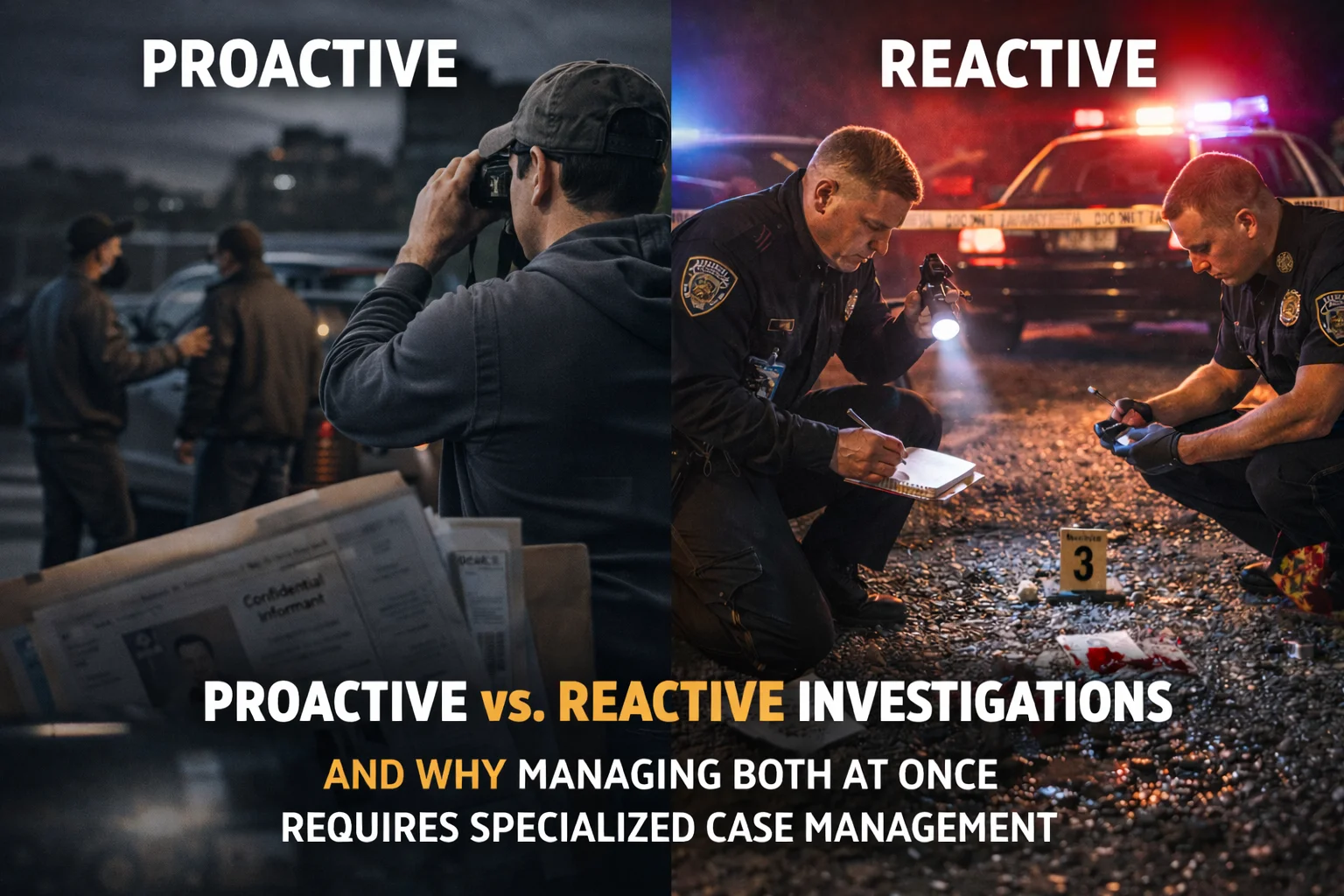
Proactive and reactive investigations case management is one of the most complex operational challenges modern law enforcement agencies face. Investigations generally fall into two categories: reactive and proactive. Both are essential. Both operate differently in practice. And most agencies must run them simultaneously across multiple units and jurisdictions.
Understanding the distinction is critical — but managing both at once requires specialized case management systems built for investigative continuity.
Reactive Investigations: Responding to What Already Happened
Reactive investigations begin with an incident. A crime occurs, a report is generated, and a detective is assigned.
These cases focus on:
-
Reconstructing events
-
Identifying suspects
-
Interviewing victims and witnesses
-
Documenting findings through supplemental reports
-
Preparing cases for prosecution
Reactive investigations are typically time-bound and externally triggered. They rely heavily on organization, follow-up, structured reporting, and coordination with prosecutors.
Traditional records systems were largely built around this reactive model.
Proactive Investigations: Preventing or Disrupting What Is Coming
Proactive investigations are initiated by law enforcement rather than by a reported crime.
Examples include:
-
Confidential informant (CI) development
-
Long-term narcotics or vice investigations
-
Undercover operations
-
Surveillance-driven investigations
-
Multi-agency task force initiatives
These cases often span months or years. They generate intelligence before chargeable offenses occur. They involve sensitive source management, cross jurisdictions, and transition between intelligence and prosecution phases.
Proactive and reactive investigations case management differs significantly because proactive cases are fluid, intelligence-driven, and continuity-dependent.
The Real Challenge: Running Both Simultaneously
In practice, agencies rarely operate in clean categories.
A narcotics detective may manage CI-based proactive cases while also handling reactive arrests, preparing affidavits, coordinating with prosecutors, and supporting task force operations.
Proactive cases often lead to reactive arrests. Reactive cases may generate new confidential informants or intelligence leads that evolve into proactive operations.
Managing these transitions requires case continuity beyond individual incident reports.
Without structured case management, investigative momentum is easily lost.
Why Traditional Systems Struggle
Most traditional systems are optimized for reactive, incident-based workflows.
They assume:
-
A triggering event
-
A discrete case lifecycle
-
Structured reporting tied to a single incident
Proactive investigations demand something different:
-
Flexible timelines
-
Secure source and intelligence handling
-
Ongoing documentation not tied to a single report
-
Cross-case and cross-entity visibility
When agencies force proactive work into reactive systems, investigators rely on spreadsheets, shared drives, personal notes, and shadow systems. This fragmentation increases operational risk, reduces supervisory visibility, and weakens institutional continuity.
Proactive and reactive investigations case management cannot rely on systems designed solely for incident reporting.
Task Forces Multiply the Complexity
Multi-jurisdictional task forces add another layer of operational challenge.
They introduce:
-
Varying agency policies
-
Shared targets across jurisdictions
-
Long-running investigations
-
Frequent personnel rotation
-
Sensitive intelligence ownership concerns
Managing this environment requires controlled information sharing, preserved case ownership, secure source handling, and long-term continuity independent of individual investigators.
Standard reporting systems rarely accommodate these realities without workarounds.
Where Case Closed Software Fits
Case Closed Software is designed specifically for proactive and reactive investigations case management within the same platform.
It supports:
-
CI-driven workflows
-
Incident-driven investigations
-
Long-term intelligence development
-
Multi-agency operations
-
Secure source handling
-
Transition from intelligence to prosecution
By preserving narrative continuity and structured case organization, it allows agencies to manage both proactive and reactive workloads without fragmentation.
The goal is not to separate investigative types — but to provide a unified structure that accommodates both.
Frequently Asked Questions
What is the difference between proactive and reactive investigations?
Reactive investigations respond to reported crimes. Proactive investigations are initiated by law enforcement to prevent, disrupt, or develop cases before formal charges occur.
Why is specialized case management needed?
Because proactive investigations require flexible timelines, intelligence documentation, and secure source management that traditional incident-based systems are not designed to support.
Can one system manage both effectively?
Yes — but only if it is built specifically for proactive and reactive investigations case management and supports transitions between intelligence and prosecution phases.
Final Thought
Proactive and reactive investigations are complementary — not competing.
The operational challenge is managing both simultaneously without losing structure, security, or continuity.
Agencies that recognize this reality invest in case management systems designed for the full investigative lifecycle — not just incident reporting.


