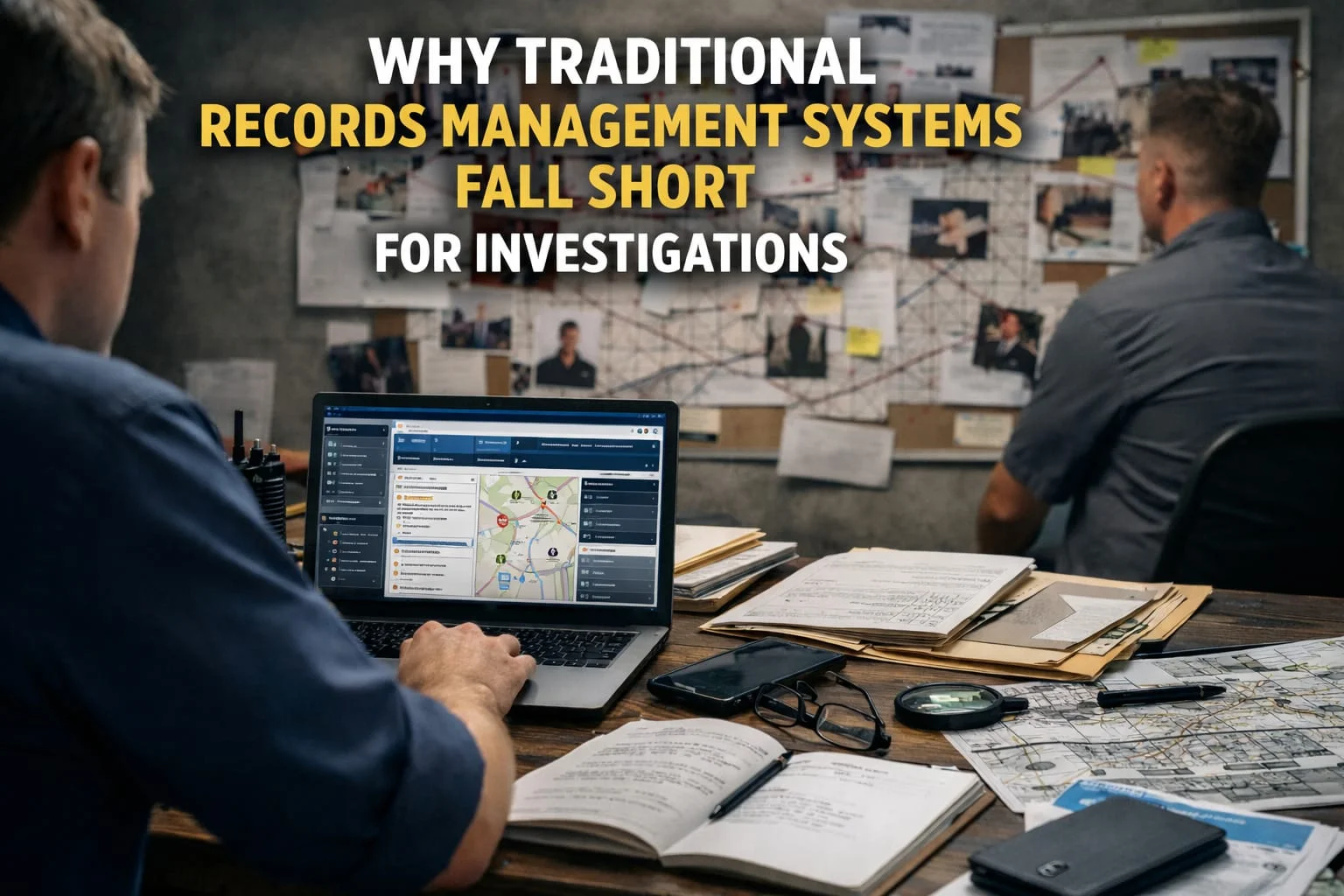
Why Traditional Records Management Systems Fall Short for Investigations
Traditional records management systems for investigations are often positioned as essential infrastructure in modern policing. Records Management Systems (RMS) are a critical backbone of modern policing. They excel at what they were designed to do: standardize, store, and retrieve incident-based reports generated by patrol, dispatch, and administrative workflows.
But investigations operate in a fundamentally different world.
For years, agencies have attempted to adapt traditional records management systems for investigations beyond their original design. The result is predictable: detectives working around the system instead of within it, fragmented case knowledge, and investigative continuity that depends far too heavily on individual memory rather than institutional structure.
The issue is not vendor quality or effort.
The issue is structural misalignment.
Why Traditional Records Management Systems for Investigations Create Structural Friction
Traditional RMS platforms are optimized for discrete incidents. They rely on fixed report structures, required fields, submission workflows, and archival processes.
Investigations are not discrete events. They are living processes.
Information is incomplete, provisional, and revisited repeatedly. New people, phones, locations, vehicles, and digital identifiers emerge over time. Supplemental reporting is continuous, not episodic. Investigative understanding evolves as facts are corroborated, challenged, or reinterpreted.
Traditional records management systems for investigations struggle because they were never designed to support evolving case narratives. This fundamental difference creates operational friction when RMS platforms are used as investigative tools.
Detectives Need a Workbench, Not a Reporting System
RMS platforms function primarily as repositories.
Investigators need something else entirely: a workbench.
Effective investigations require:
-
A central case narrative that grows over time
-
Ongoing supplemental reporting without structural friction
-
Dynamic association of people, locations, devices, and events
-
Continuity that survives personnel turnover
When detectives are forced into RMS workflows, they compensate by creating parallel systems—shared drives, notebooks, spreadsheets, personal notes, and email threads. That fragmentation introduces risk, inconsistency, and loss of institutional knowledge.
Traditional records management systems for investigations often unintentionally encourage this workaround behavior because they prioritize reporting compliance over investigative workflow.
Why Traditional Records Management Systems Limit Investigative Intelligence
Investigations rely on relationships, patterns, timelines, and corroboration across cases.
Traditional RMS systems treat information as static records tied to individual incidents. Investigators, however, need to understand how information connects and evolves across time, people, and cases.
Without relational visibility, detectives are forced to mentally reconstruct connections the system was never designed to show. This limits analytical depth and increases the likelihood that important patterns go unnoticed.
As investigative workloads increase and data complexity grows, systems that lack dynamic entity association and cross-case intelligence visibility become increasingly restrictive.
Specialized Units Have Specialized Needs
Major Crimes, Narcotics, ICAC, Gang Units, and Task Forces share common operational realities:
-
Long-running investigations
-
Heavy supplemental reporting
-
Sensitive source and intelligence handling
-
Supervisory oversight without operational disruption
Traditional records management systems for investigations are built for agency-wide uniformity and administrative consistency. Investigative units, however, require depth, flexibility, and context-specific workflows that standard RMS platforms are not structured to provide.
This mismatch forces specialized units to adapt rigid systems to fluid investigative environments.
Why a Separate Investigative System Is the Right Answer
RMS is necessary — but not sufficient.
A dedicated investigative case management system operates alongside RMS, focusing specifically on detective workflows. It reduces duplication, preserves investigative continuity, and protects institutional knowledge without replacing existing records systems.
This separation allows RMS platforms to continue serving their core reporting and compliance function, while investigative systems support dynamic case development and intelligence analysis.
Traditional records management systems for investigations can remain part of the ecosystem — but they should not carry responsibilities they were never built to handle.
Where Case Closed Software Fits
Case Closed Software is not an RMS replacement.
It is an investigative case management platform built around how detectives actually work. It provides:
-
Case-centric organization
-
Continuous supplemental reporting
-
Secure intelligence and source handling
-
Entity visibility across cases
-
Unit-level configuration aligned with investigative needs
By focusing specifically on investigative workflows, it supports investigations as processes — not static records.
Frequently Asked Questions
Why are traditional records management systems for investigations inefficient?
Traditional records management systems are designed for incident reporting, not long-term investigative continuity. This creates workflow friction, fragmented intelligence visibility, and reliance on manual workarounds.
What is the difference between RMS and investigative case management systems?
RMS platforms focus on standardized incident documentation and compliance reporting. Investigative case management systems support evolving narratives, cross-case intelligence, supplemental reporting, and relational analysis.
Final Thought
Investigations are processes — not records.
Traditional records management systems for investigations were built to document events, not to manage evolving case intelligence. Law enforcement agencies that recognize this distinction can better align their technology with how detectives actually work.


