Case Management Is the Work — Analytics Are the Extras in Investigations
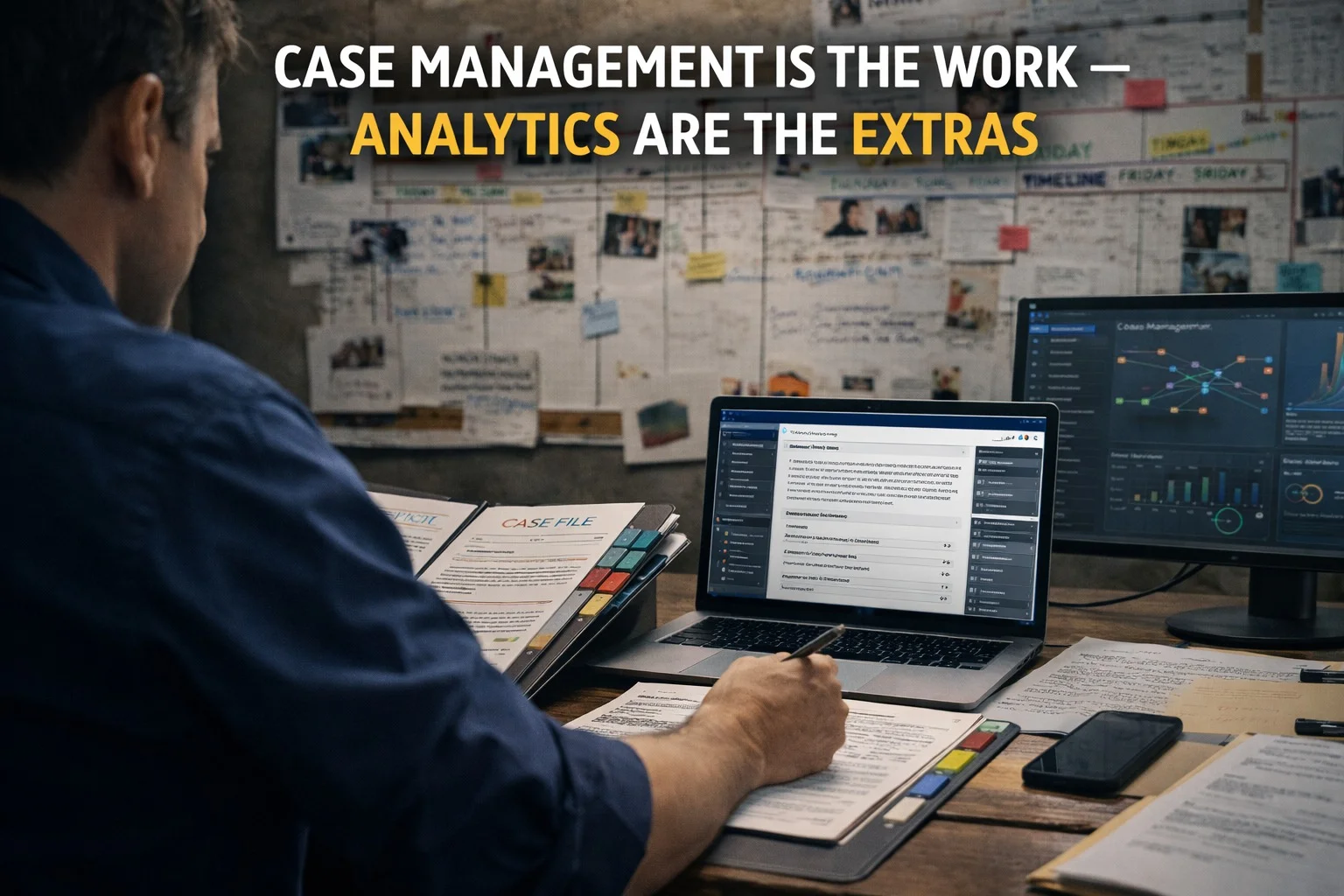
Case management software for investigations is often marketed around advanced analytics, artificial intelligence, and visual dashboards. But in real investigative environments, the core work is far less glamorous. Case management is the work — analytics are the extras.
Popular culture has done investigators no favors. Television and movies portray investigations as intricate puzzles solved by a single breakthrough: a brilliant insight, a hidden connection, or a last-minute revelation. Those cases exist — but they are the exception, not the rule.
The vast majority of investigations are won or lost on blocking and tackling: organization, continuity, documentation, follow-through, and time. That reality should drive how agencies evaluate case management software for investigations.
The Myth of the “Whodunnit” Investigation
Most cases are not mystery novels.
They do not hinge on uncovering one missing data point buried in a massive dataset. They hinge on keeping track of evolving information, managing interviews and supplements, coordinating across time and units, and ensuring nothing gets missed as weeks turn into months.
When investigations fail, it is rarely because investigators lacked advanced analytics. It is because cases drifted, details were lost, or continuity broke down.
Strong case management software for investigations prevents that drift by centralizing information and preserving structure.
What Investigators Actually Do Every Day
Real investigative work involves:
-
Writing and updating supplemental reports
-
Tracking people, vehicles, devices, and digital identifiers
-
Logging interviews and evidence
-
Coordinating with prosecutors and supervisors
-
Reopening cases after interruptions or personnel changes
None of this is glamorous — but all of it is essential.
Effective case management software for investigations must support this daily operational rhythm. If the system complicates documentation or fragments information, it works against the investigation instead of strengthening it.
The Real Value of Case Management Software for Investigations
The primary job of a case management system is not to discover insight — it is to protect the investigation from entropy.
A strong system:
-
Keeps information centralized
-
Preserves narrative continuity
-
Simplifies supplemental reporting
-
Reduces reliance on memory or shadow systems
-
Allows supervisors to understand case status without disruption
Good structure compounds over time. Weak structure creates friction, duplication, and risk.
Case management is not administrative overhead. It is investigative infrastructure.
Where Analytics Actually Fit
Analytics are supporting tools, not the core job.
They matter most:
-
In large or complex investigations
-
When patterns are not visible through routine review
-
After data is already well managed
Analytics amplify good case management and magnify bad case management.
If case documentation is fragmented or incomplete, analytics cannot fix it. If information is structured and consistent, analytics become powerful accelerators.
But they are accelerators — not replacements for disciplined case work.
Why Agencies Need Structure First
Before investing in dashboards and predictive tools, agencies should ensure their case management software for investigations supports:
-
Continuous supplemental reporting
-
Cross-case visibility
-
Structured entity tracking
-
Long-term continuity
-
Supervisor insight without operational disruption
Without strong case management foundations, analytics become surface-level enhancements instead of meaningful force multipliers.
Where Case Closed Software Fits
Case Closed Software is built around a simple truth: managing the case is the investigation.
It emphasizes:
-
Case-centric organization
-
Strong narrative reporting
-
Clear visibility across cases
-
Structured supplemental documentation
-
Visual analytics that support thinking rather than replace it
The goal is not to overwhelm investigators with dashboards. The goal is to give them a stable investigative foundation.
Frequently Asked Questions
Why is case management software for investigations more important than analytics?
Because most investigative failures stem from lost continuity, incomplete documentation, and poor organization — not lack of advanced data modeling.
Do analytics still matter in investigations?
Yes. Analytics are powerful tools when built on top of well-managed case data. They enhance structured investigations but cannot replace disciplined case management.
What should agencies prioritize first?
Agencies should prioritize case management software for investigations that strengthens documentation, continuity, and cross-case visibility before focusing on advanced analytics features.
Final Thought
Investigations fail when cases lose structure, continuity, and momentum.
Case management is the work.
Analytics are the extras.
Agencies that understand this distinction build stronger investigative foundations — and make smarter technology decisions.


